Showing posts with label Baseball. Show all posts

Thursday, November 6, 2014

What Answer for the Despicable Alex Rodriguez?


Alex Rodriguez

The ESPN headline rang hollow:  A-Rod confessed in DEA meeting.  After his one season suspension, Rodriguez is officially back with the Yankees.  He proved himself to be a despicable character for lying about his use of performance-enhancing drugs.  To learn now that he actually had admitted to such use, that is, in a January 29th meeting with the Drug Enforcement Administration, while continuing an elaborate public campaign of denial, unloading hysteria of indignation, and hurling lawsuits at whomever makes him doubly despicable.

Why?
Rodriguez, who turns 40 next summer, played in just 44 games in 2013 and hit seven home runs to increase his total to 654, fifth on the career list. He is owed $61 million for the final three years of his contract with the Yankees. He could receive an additional $6 million each for five milestones that the team designates as historic achievements.
How about potentially $91 million worth of answers?

Wednesday, October 1, 2014

ESPN Sports Science: The Catch


Willie Mays was the man, and little did he know it, when he made this fateful catch in Game 1 of the World Series on September 29th 1954.  It was top of the 8th inning, and the New York Giants and Cleveland Indians were knotted up at 2-2.  Had Mays not made The Catch, the Indians would've taken the lead and perhaps won the ballgame.  As it were, the Giants beat them in the 10th inning, en route to a championship sweep.  Had Mays not made that catch, the complexion of the series may have altogether gone in favor of the Indians.  John Brenkus and his Sports Science pals draw on sophisticated technology and cool graphics to show us how truly remarkable Mays' catch was.  They show us what a uniquely gifted athlete can do that the vast majority of us non-athletes probably cannot do.

Monday, September 29, 2014

ESPN Sports Science: Run or Slide?


I love these ESPN Sport Science features, even though it's really more technology, analytics and cinematography than science.  The conclusion here seems clear enough for base runners:  Run through first base, and don't slide.  But John Brenkus himself points out that for a very short segment, the sliding base runner actually lurches forward faster than the run-through base runner.  Sure, the base runner decelerates and loses time to the bag, if he launches into his slide too soon.  However, if he were to time that slide closer to the bag, he would actually get there fractions of a second sooner than the run-through base runner.  A true scientific study would have experimented with different distances from bag, and determined that at a certain point it would be better to slide than run.

Monday, January 13, 2014

2014 First-Ballot Hall of Famers


It was exciting to hear that two former-Chicago baseball players were inducted into the Hall of Fame last week, on first ballots, no less.  Greg Maddux was one of them, and while he played more seasons for the Braves (11) than the Cubs (7 + 3), I choose to look at him as a Cub.  He didn't have a lot of heat on his fastballs, but he had amazing control and man can he make that baseball dance as it approached home plate.


I don't follow the White Sox, as I'm mainly a North Sider fan in Chicago.  Still it was exciting that Frank Thomas made it to the Hall.  I listened to his press conference on ESPN 1000 Chicago, and he sounded so delighted and grateful.  It was clearly special for him to be a first-ballot Hall of Famer.  He knew Maddux would get into easily, but admitted that he wasn't so sure about himself, because he played a number of years as in DH (designated hitter).  


In the 1990s, the Braves seemed to own the post-season, and won the World Series in 1995, with Maddux onboard.  Tom Glavine was the third HOF inductee last week, and those Braves had such snipers in the pitching staff, John Smoltz being among them.  Glavine that had steely look, the kind of look that would kill you with a pitch.  He'd remain unmoved and dispassionate in his demeanor, as if he were merely turning the pages of a book.  

Congratulations to these three gentlemen.

Image credits: 2014 Baseball Hall of Fame Inductees.

Thank you for reading, and let me know what you think!

Ron Villejo, PhD

Friday, August 23, 2013

SportsNation and Twitterverse on Ryan Braun


Ryan Braun


ESPN SportsNation has spoken on Ryan Braun
A statement may serve a legal purpose - Ryan Braun apologizes for PED use - but in general such a formality is meaningless from a relationship or reputation standpoint.  They are calculated and one-sided, when the crux of any resolution to this shameful episode requires unguarded, two-way conversation.  He needs to face the media and fans, and engage in a Q&A.


(image credit @darrenrovell)
You see, I wonder if Braun is telling the truth now.  I wonder if his statement, for instance, is laced with half truths or omitted truths.  How do we know that he will actually stop using PEDs?  He is perfectly capable of lying again.

Case in point:

Braun makes like the Fonz, in this one hilarious scene:

Armstrong was masterful, in keeping up the charades and withstanding attack after attack, for years on end.


That's right, Skip, you tell them!


Thank you for reading, and let me know what you think!

Ron Villejo, PhD

Sunday, August 11, 2013

Graft Reconstruction of Ulnar Collateral Ligament


30 for 30 Shorts:  Tommy and Frank

Graft reconstruction of the ulnar collateral ligament of the elbow is better known in baseball, simply, as Tommy John surgery.  Which should really be Frank Jobe surgery, after the surgeon who devised this career-saving medical procedure.

This documentary by ESPN tells a wonderful story of patient and physician.  Jobe reluctantly agreed to do a procedure that sounded more experimental than established, and John, perhaps desperate to resume his baseball career, wanted to have it done.

The things was, Jobe could do the procedure, and John would just an unlikely to ever pitch again.  He added that, if he didn't do it, then for sure John would never pitch again.  The odds of success apparently were 1 in 100, based on Jobe's scant experience and knowledge about the experience.  With the known and unknown risks laid out duly on the table, they went forward.

(image credit)

(image credit)

Sports is a thrill to perform, and it's a thrill to watch.  But it puts extraordinary stress on particular parts of the body, depending on the athlete's specialty:  the feet, from dancing en pointe; the elbow, from playing tennis; and the head, from the pounding of boxing.  So medical research and procedure have had to evolve along side sports, in order for these athletes to have any hope of plying their trade.

John had surgery on September 25, 1974, and spent the 1975 season in rehabilitation.  In 12 seasons prior to it, he won 124 games.  But he won 164 games, in the 14-season second-half of his career.  So this wasn't just a resumption of his pitching, but also an improvement of his career.

There is another key figure in the Tommy John story, whom we don't often hear about - Mike Marshall.  He was Dodger teammate of John, and won the Cy Young in 1974 as a relief pitcher and was an All-Star in 1974 and 1975.  Here is a bit on him from Wikipedia:
Marshall teaches and advocates a pitching method he developed that he "believes could completely eradicate pitching-arm injuries."  He wants pitchers to have a smooth transition. To pitch[,] the arm has to externally rotate (hand lays back) before the ball accelerates. With traditional pitchers[,] the thrower often lifts his elbow before his hand (also called scapula loading); this leads to the ball coming up late and the arm to externally rotate late. The elbow will be accelerated forward while the hand still goes backward, which creates enormous stress on the arm. 
Marshall instead wants pitchers to externally rotate early as they swing their arm up. That means the will lift the hand before the elbow, so that the wrist faces away from the body and up, the hand is above the elbow when the front foot touches the ground, which leads to a smooth transition without a "forearm bounce," as Marshall calls it (Marshall believes this causes UCL injuries, which require Tommy John surgery). He wants to first lay back the forearm and then accelerate by rotating the body instead of bending over, in order to protect the elbow against injury.
John worked with Marshall, as part of his rehabilitation in 1975, before coming back to MLB pitching in 1976.  

About 500 pitchers have had Tommy John surgery, in the nearly 40 years since Jobe's pioneering.  Presumably they all returned to the mound with solid, if not resounding, effectiveness.

Thank you for reading, and let me know what you think!

Ron Villejo, PhD 

Sunday, October 28, 2012

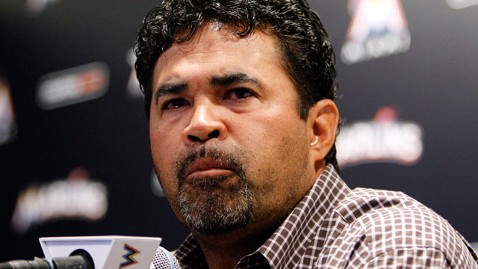
Ozzie Guillen: Baseball Success, PR Nightmare


Surely the Miami Marlins' front office must've known they were hiring an outspoken, often irreverent manager in Ozzie Guillen.  They knew he had a successful track record as a player, coach and manager, and had won the favor of many players he managed.  But after Ozzie's ill-advised "I love Fidel Castro ... I respect Fidel Castro" quip on Time Magazine, their season wavered like a top losing its spin, flirted with the Chicago Cubs' own MLB bottom-feeding season, then gone, history, hasta-la-bye-bye.  Ozzie fired, but left fat in the wallet.     

The front office wanted a prominent, capable Latino manager to help advance their commercial, sports and cultural plans in a predominantly Cuban-American community in Miami.  A short year later, they decided they didn't want that manager after all.

Maybe they should've engaged Eva Longoria as the true diamond in the dugout, instead.

How free is freedom, really?  


There is no questioning Ozzie's freedom to speak his mind.  But we know that freedom comes with a responsibility to be respectful and therefore an accountability to others.  Surely he must've known that the community he had recently joined would go ballastic, if he said anything even remotely praiseworthy of the Cuban leader.

What was he thinking, man?     

I am one of those who've been around the block, literally, having crossed continents and back and having slid into the second half of life.  So I know that, even though I rack my brains now and then trying to figure people out, there is a place in the world for everyone, including Ozzie Guillen.

What is that place, and what is his purpose?

Ozzie plays the Fool

ESPN senior writer LZ Granderson offered an insightful take on this, and I'd like to build on it. 

You see, in Shakespeare, the Fool has a prominent role in the royal court.  He is a figure, if fortunate enough, who is installed for the King's amusement.  Think about the Joker in a deck of cards, and you have a sense for how wild yet useful the Fool is.

The Fool, most importantly, has license to speak true to the King, that is, without getting punished.  In turn, the King may seek, and value, such truthfulness, because he sees only a court full of yes-Your-Highness, curtsy-every-second subjects.  The Fool comes across as silly and dumb, but may actually be smart as a whip and have a finger on the courtly pulse.

LZ is correct in that Ozzie's slurs are a prompt to have a dialogue on very sensitive, clearly incendiary issues.  But more than that, I think, people like Ozzie serve a critical societal and psychological purpose.    

A society hung up on political correctness (PC) may keep an air of civility, by and large.  Each word is carefully crafted, before uttered, or else it lands the utterer in hot water.  Each manner is dressed up, so as not to be offensive to the eyes.  But the reason PC is often itself the butt of politically incorrect sarcasm is that it creates a society that is plastic and unreal, even repressed, ultimately dissatisfying and untenable.

Punish Ozzie for the wrong he said, because he deserves it.

Praise Ozzie for that same wrong he said, because we, as a society, need to be shaken from our staid civility now and then, to face these issues and engage in difficult conversations.  

Finally, no doubt, Ozzie isn't the only one who has those very sentiments about Fidel Castro.  In a way, then, he is the vehicle by which those silent (maybe not all so silent) sentiments are vicariously delivered.

So, the next time the Chicago Shakespeare Repertory stages "King Lear," they know whom to cast to play the role of you-know-what! 

Thank you for reading, and let me know what you think!

Ron Villejo, PhD